On May 25, 2026, the last day of their 42nd season, the volunteers on the back patio of the Point Vicente Interpretive Center saw no gray whales. They still had plenty to watch. About a mile offshore, a probable fin whale surfaced in a group of common dolphins feeding on a fish boil. A humpback arched up near a second group, and a minke whale foraged for half an hour just inshore of the boil. Over the first seven hours, the team counted more than a dozen groups of dolphins working bait balls, along with thousands of birds.
The whiteboard in that day's team photo showed the season's final count: 214 gray whales southbound and 445 northbound.
The team is back on Tuesday, December 1, when the American Cetacean Society Los Angeles Chapter starts its 43rd season. If you walk the bluffs or bring guests out to Point Vicente, it helps to know what that whiteboard measures, because last season the national estimate went up while the patio's northbound count fell to a record low.
A cliffside count that has run since 1984
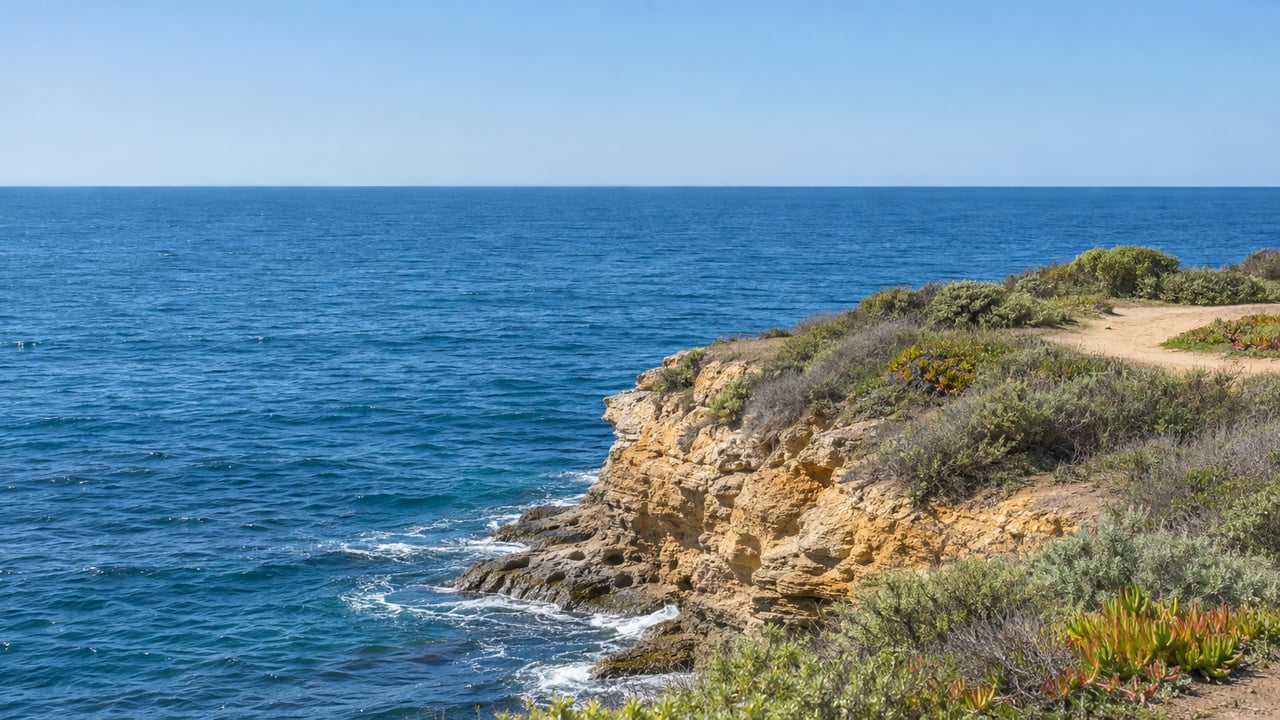
The ACS/LA Gray Whale Census and Behavior Project has run full seasons on the Palos Verdes Peninsula since 1984. The only breaks came during COVID-19, when the 2019–20 season closed on March 20 and the next season did not open. Since the 1985–86 season, its main station has been the PVIC patio, which the center and the City of Rancho Palos Verdes make available. The patio sits 137 feet above kelp beds and rocky shoreline, and the sea floor drops off sharply close to shore. The observers are trained volunteers from the American Cetacean Society, the Cabrillo Whalewatch Program and the general public. Each season runs in daylight from December 1 through late May.
The work is more methodical than a casual visit suggests. Every observer uses binoculars fitted with reticles and a compass, some confirm sightings through spotting scopes, and the team records visibility and sea conditions twice an hour. In 2024–25, observers were on duty for 173 days and averaged about 11.6 hours a day. One hundred volunteers put in 8,767 hours. ACS/LA calls them "The People Who Count."
Three seasons on the whiteboard
These are the last three Point Vicente seasons, using ACS/LA's own season-end figures:
| Season | Southbound grays | Northbound grays | Southbound calves | Northbound calves |
|---|---|---|---|---|
| 2023–24 | 225 | 579 | 22 | 34 |
| 2024–25 | 130 | 485 | 0 | 8 |
| 2025–26 | 214 | 445 | 17 | 16 |
All of these sit well below earlier seasons. Before 2023–24, southbound totals at Point Vicente had ranged from 293 to 1,902 and northbound totals from 521 to 3,412. In 2024–25 the team set record lows in both directions and logged no southbound newborn calves for the first time. On 50 of the 173 days, they saw no gray whales at all, often in excellent viewing conditions.
Last season's southbound count of 214 was the second lowest on record, and the northbound 445 set a new low. The calves are where the numbers improved. Calves made up 7.9 percent of southbound gray whales in 2025–26, compared with zero the season before, and 3.6 percent of northbound whales, up from 1.6 percent. Census Director Alisa Schulman-Janiger called the season's highlight "cautious optimism."
Single days on the patio tell a similar story. In July 2026, Schulman-Janiger told Spectrum News that last season's best day was 30 whales. Good days in earlier years brought 80 to 100, and the station's record for a single day is 152.
The national estimate went up over the same winter
NOAA Fisheries counts gray whales migrating south past a field station on the central California coast. From that count it estimated the Eastern North Pacific population at 15,930 to 20,530 whales for 2025–26, or about 17,750 on average. In that July announcement, NOAA gave the previous year's estimate as 11,690 to 13,190, one of the lowest since counting began in the late 1960s.
So last winter the population estimate jumped while Point Vicente logged a record-low northbound count. Most of that gap comes down to where the whales swim.
ACS/LA has always described its census as a nearshore sample. Most gray whales take offshore routes past the Peninsula, especially when heading south. The count shifts with route choice and weather, and it is not meant to be read as a population total. A whale that passes several miles out never shows up on the patio whiteboard, whatever happens to the overall population.
NOAA treats its own increase with caution as well. In its July 15, 2026 feature, the agency says the jump probably exceeds what the population could produce through births, since the last calf estimate, from 2025, was 85, the lowest on record. Its researchers are now studying migration timing and the assumptions about whale behavior built into the estimate. NOAA research scientist Aimée Lang, who helps lead the counts, put the question this way in that feature:
"We know that we don't see every whale. One of the questions raised by our most recent count is whether we see a consistent proportion of the population every year, or whether other factors affect how much of the population we see and count."
NOAA's population abundance page, last updated October 23, 2026, says the same thing. Gray whales may be changing their migration patterns, which would change how many are available to be counted in a given year. ACS/LA has also recorded shifts in timing. Its 2024–25 summary describes another late southbound migration, possibly because whales stayed longer on northern feeding grounds.
The whiteboard tells you how many gray whales came close enough to the Peninsula to be counted from this bluff. That makes it a good guide for planning a visit and a poor guide to the size of the population.
When to go this winter
The patio count usually rises and falls on a predictable schedule, though the exact weeks change from year to year. These are ACS/LA's recorded peaks:
- December. The season opens December 1. In most years, southbound whales are still ahead of their peak.
- January, for southbound whales. The busiest southbound week was January 7–13 in 2021–22, January 10–16 in 2022–23, and January 25–31 in 2024–25.
- Late February, the turnaround. In both 2023–24 and 2024–25, the official switch from mostly southbound to mostly northbound traffic came on February 21.
- March, the main northbound pulse. The peak week fell between February 28 and March 6 in 2021–22, March 22–28 in 2022–23, and March 15–21 in 2024–25.
- Late April, mothers and calves. In 2022–23, the northbound calf count peaked on April 26, and cow-calf pairs peaked the week of April 24–30.
Last season's numbers matter most in that final window. Calves were the one figure on the whiteboard that clearly improved, and late April is when mothers and calves tend to pass closest to the patio.
The other whales off the patio
The census logs every marine mammal it can identify, not just gray whales, and that list makes quiet gray-whale days worth the trip too. In 2024–25 the team recorded blue, fin, humpback, minke and sperm whales. They also logged common dolphins, coastal and offshore bottlenose dolphins, Pacific white-sided dolphins, Risso's dolphins, California sea lions, harbor seals and an elephant seal. The May 25 closing day, with fin, humpback and minke whales feeding among the dolphins, came at the end of a gray whale season.
ACS/LA posts daily counts and sighting notes during the season on its Latest Whale Count page and its Facebook page. If you check them before heading out, you'll know whether the week's activity is gray whales or dolphins and birds working bait offshore.
Visiting, and joining the count
According to the City of Rancho Palos Verdes, the Point Vicente Interpretive Center museum and gift shop are open daily from 10 a.m. to 5 p.m., the grounds are open from dawn to dusk, and the museum accepts donations. The census team works on the back patio, and the public is welcome to stop by and watch.
To go beyond watching, Census Director Alisa Schulman-Janiger takes volunteer inquiries at [email protected], and the census page links to her recorded gray whale talk for background.
The center also hosts the city's spring Whale of a Day festival. In 2026 the 41st annual event moved from April 11 to April 25 because rain was forecast. It offered bluff-top whale watching, guided tours of the historic Point Vicente Lighthouse grounds, live entertainment and booths from marine conservation groups. Watch the city's announcements for next spring's date, which will come around the same late-April stretch when calves have peaked in past seasons.
If you're planning a full Peninsula weekend around a patio visit, our guide to the Palos Verdes weekend that doesn't require a room at Terranea covers more local routines, and our Palos Verdes neighborhood page has the bigger picture.
At DK Realty Grp, Deb Kahookele keeps track of what makes each corner of Palos Verdes worth living in. If you want to know what your Peninsula home is worth this season, start with a free home valuation.